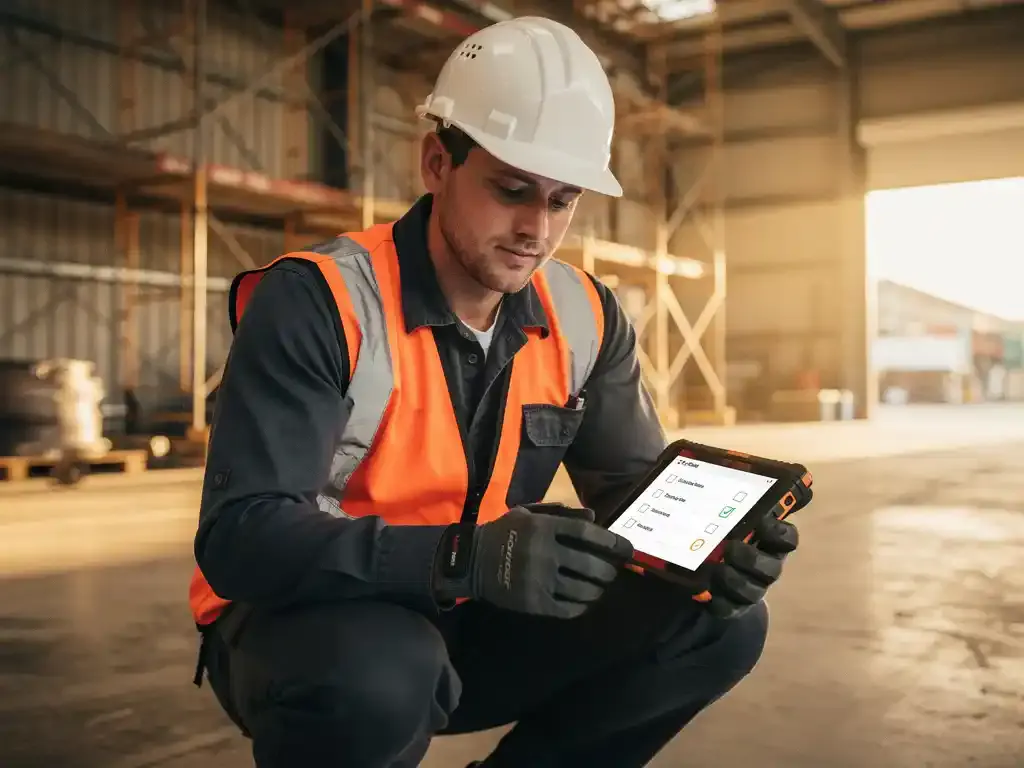

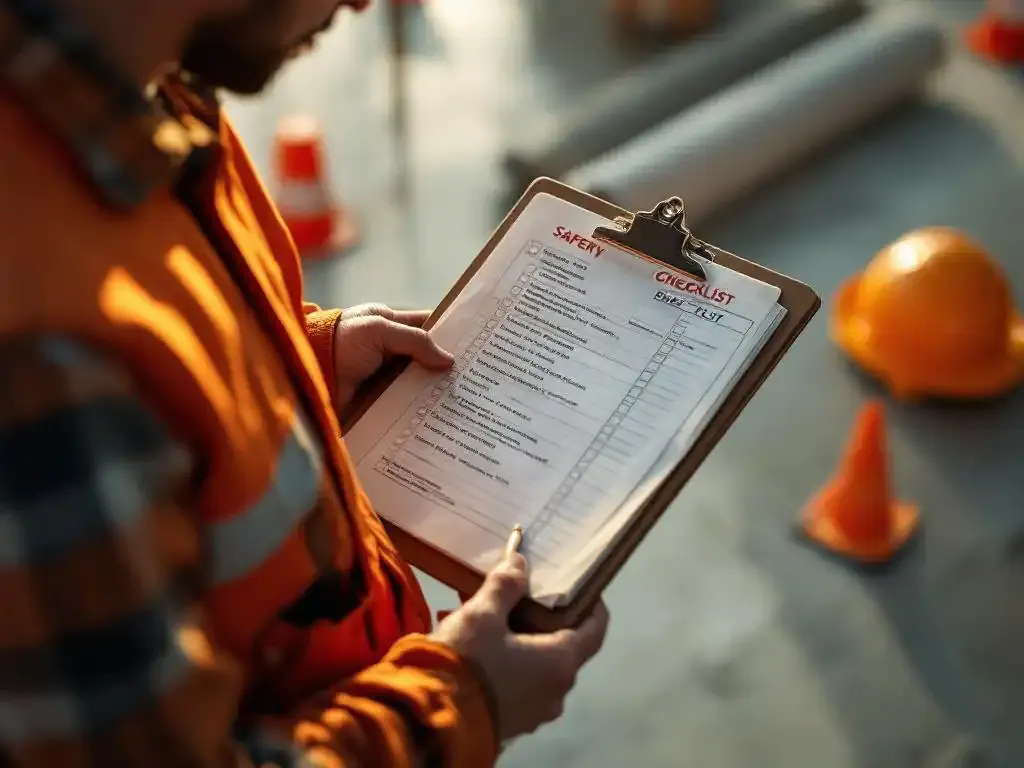
A point of work risk assessment (POWRA) is a short risk check that workers carry out themselves, at the point of work, just before they start a task. In two to five minutes they ask whether the situation still matches the plan, whether new hazards have appeared and whether it is safe to start. The POWRA ends with one decision: start the work, or stop and sort it out first.
The POWRA is common in UK construction, utilities, rail and facilities management, and you will also hear the same idea as a dynamic risk assessment or a Take 5. This article explains what a POWRA is, what the law says, how it differs from a toolbox talk and how it fits into one safety process with toolbox talks and inspections.
What is a POWRA?
A formal risk assessment is done in advance, at a desk, for a type of task. But the real workplace never looks exactly like the plan. The scaffold has been altered, it has rained, another trade is working overhead, a tool is missing. The POWRA is the moment the worker checks for exactly those differences.
A typical POWRA covers five questions:
- Do I understand the task? What am I going to do, in what order and with whom?
- Do I know the hazards around me? Including above, below and beside me, and from other work nearby.
- Do I have the right PPE and tools? Are they in good condition and inspected?
- Is the work area safe? Barriers, access, lighting, isolation, permits in place.
- Can I get away safely if something goes wrong? Escape route, emergency contact, first aid.
If any answer is "no" or "not sure", the work does not start until the issue is resolved, if necessary with the supervisor. You can download a free POWRA form to try it out.
POWRA, dynamic risk assessment, Take 5 and FLHA
The practice goes by several names. These are the ones you are most likely to come across.
| Term | Where you hear it | What it means |
|---|---|---|
| Point of work risk assessment (POWRA) | Construction, utilities, rail, facilities management | A short, often card-based check by the worker at the place of work before starting |
| Dynamic risk assessment | Emergency services, security, care, field work | Continuous assessment of risk while the situation changes, rather than only once before the start |
| Take 5 | Construction, mining, engineering contractors | A five-step routine, typically: stop, look, assess, control, proceed |
| Field level hazard assessment (FLHA) | Energy, oil and gas, international contractors | A field-level check of hazards and controls before and during a task |
| Last minute risk assessment (LMRA) | Dutch and Belgian contractors and their UK projects | The same pre-start check, under the Dutch term |
The details differ, but the principle is identical: the person who does the work makes the final check, at the moment and place it matters.
Is a POWRA a legal requirement?
UK law does not mention a point of work risk assessment or Take 5 by name. It does require a suitable and sufficient risk assessment (regulation 3 of the Management of Health and Safety at Work Regulations 1999) and requires employees to take reasonable care of themselves and others (section 7 of the Health and Safety at Work etc. Act 1974).
A point of work check is a practical way to make the formal risk assessment work in real conditions. It does not replace the formal assessment or the method statement. It checks that the controls they describe are actually in place today, at this spot.
How does a POWRA differ from a regular toolbox talk?
Both are short and practical, but they have different jobs.
| Toolbox talk | POWRA | |
|---|---|---|
| Purpose | Transfer knowledge on a safety topic | Check whether this task can start safely now |
| When | Planned, for example weekly or monthly | Immediately before each task, or when the situation changes |
| Who leads | Supervisor, site manager or health and safety adviser | The worker, for themselves; in a team each person checks |
| Content | One topic, explained and discussed | Fixed questions applied to the current situation |
| Outcome | Knowledge, awareness, a record of who took part | A go or no-go decision |
| Duration | 5 to 15 minutes | 2 to 5 minutes |
The two strengthen each other. A toolbox talk explains the hazards of, for example, working near live services. The POWRA is the moment the worker checks whether those hazards are present at this location today. You can even run a toolbox talk on how to do a good POWRA: see the POWRA toolbox talk. For more on short briefings at the start of the day, read the difference between a safety talk and a pre-start briefing.
How POWRA, toolbox talks and inspections fit into one safety process
The POWRA works best as part of a wider routine, not as a separate form.
- Risk assessment and method statement: the plan, made in advance.
- Toolbox talks: explain the risks and controls, and refresh knowledge regularly.
- Pre-start briefing: agrees the day's work and specific hazards with the team.
- POWRA: each worker checks the actual situation just before starting.
- Workplace inspections: supervisors check regularly that controls are in place and work is done safely.
- Follow-up: findings from POWRAs and inspections feed into new toolbox talks and updated risk assessments.
When a POWRA leads to a "stop", that is not a failure but the system working. Record it, solve the issue and use it as input for the next toolbox talk. Read how to set this up in practice in performing a POWRA: checklist and real-world example, and see how to run a short safety briefing before work starts.
Common mistakes with POWRAs
- Ticking the card without looking. A routine that becomes automatic loses its value. Vary the questions or ask for one specific observation.
- Doing it at the cabin instead of at the workplace. The check only works where the work happens.
- No consequence for a "no". If stopping is not supported by supervisors, workers will stop stopping.
- Nothing happens with the results. Collected cards that nobody reads teach workers that it is paperwork.
Paper card or a POWRA app?
Many sites still use a paper card or a pocket booklet. That works for the check itself, but the cards end up in a van or a bin, and nobody sees the "no" answers in time. A digital POWRA app on the worker's phone keeps the same questions, adds a photo when something is wrong and sends a stop straight to the supervisor. The threshold matters: if the app needs a login or a download, the check gets skipped. That is why a check on WhatsApp, which workers already use, works so well on mixed sites.
Frequently asked questions
What does POWRA stand for?
Point of Work Risk Assessment: a short risk check that workers do themselves at the place of work, just before starting a task. Dutch and Belgian contractors call the same check a POWRA (point of work risk assessment).
What is the difference between a POWRA and a dynamic risk assessment?
They overlap strongly. A POWRA is usually a structured check at the start of a task. A dynamic risk assessment emphasises continuing to assess as conditions change during the work. In practice, a good POWRA is repeated whenever the situation changes.
Is Take 5 the same as a POWRA?
In essence, yes. Take 5 is a five-step version of the same idea: stop, look, assess, control and then proceed. The name differs per company and country.
Who carries out a POWRA?
The worker who will do the job. Working as a team, everyone does their own check and the team discusses any issues together before starting.
Does a POWRA have to be recorded?
There is no specific legal requirement in the UK to record each point of work check. Many principal contractors and clients do require it, and a record helps you show that risks were checked before work began and that issues were acted on.
How E-lia helps
With E-lia, workers complete the POWRA via WhatsApp on the phone they already carry. No app, no login, done in a minute, with a photo when something is not right. Every completed POWRA appears in your dashboard straight away, and a "stop" reaches the supervisor immediately. POWRAs sit alongside your toolbox talks and inspections, so findings flow straight into the next talk.
Try a POWRA via WhatsApp
Receive a demo POWRA on your phone and see how the result appears in the dashboard.