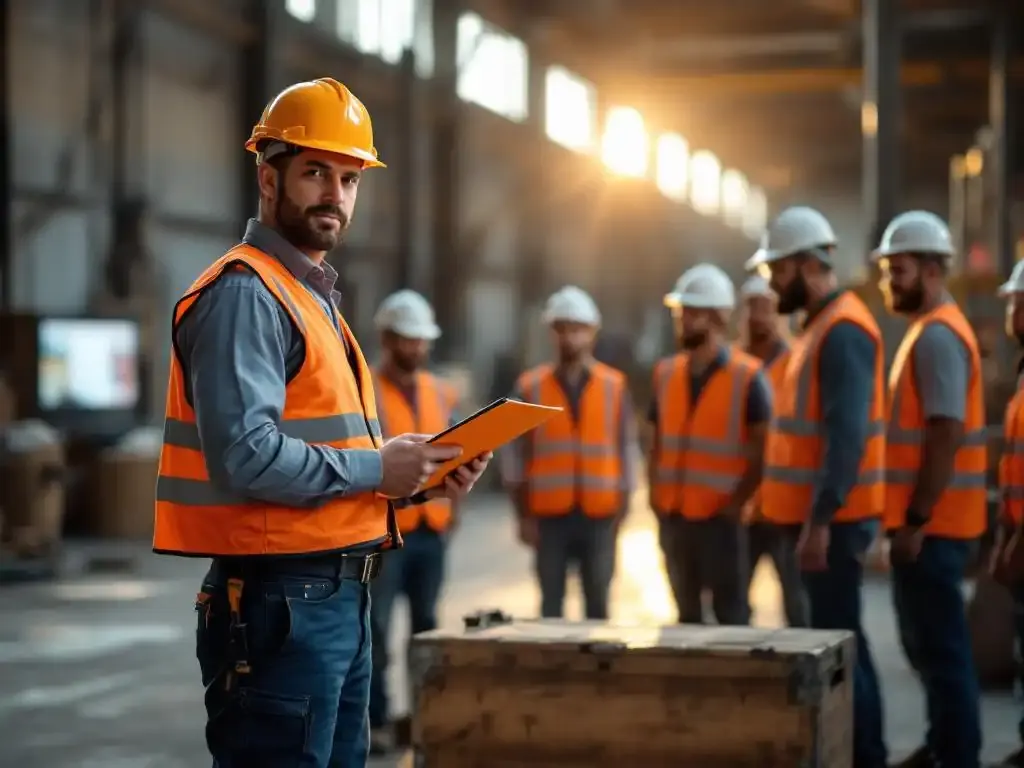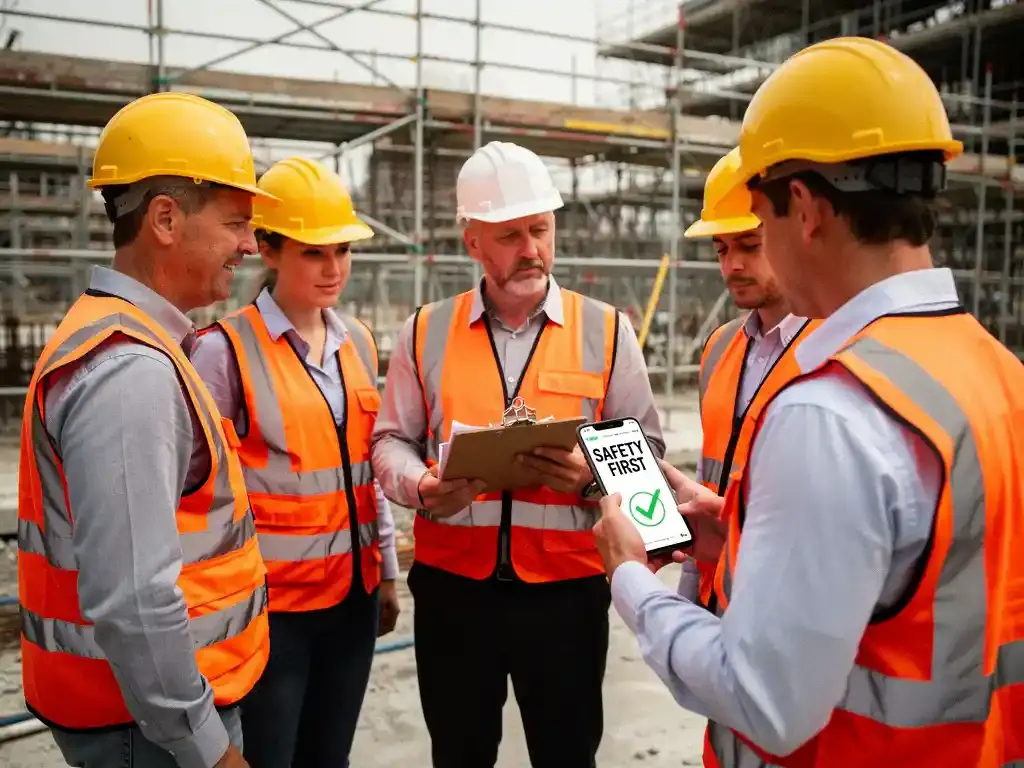


Walk onto almost any UK construction site, factory floor or depot early in the morning and you will see it: a supervisor and a small group of workers, ten minutes, one safety topic. That is a toolbox talk.
This article explains what a toolbox talk is, why some people call it a toolbox meeting or a safety talk, whether you are legally required to hold one, and how to run and record one properly. You will also find a worked example you can use on your own site tomorrow.
What is a toolbox talk?
A toolbox talk is a short, informal safety session held at or near the place of work, focused on one specific hazard or safe working practice. It is usually led by a supervisor, foreman or site manager and lasts around 5 to 15 minutes.
The name comes from construction: crews would gather around the toolbox or the back of the van before starting work. Today toolbox talks are used in construction, manufacturing, logistics, utilities, facilities management, food production and many other sectors.
Three features set a toolbox talk apart from other safety training:
- One topic: a single, practical subject such as ladder safety, manual handling or dust control, not a full course.
- At the point of work: on site, in the workshop or in the welfare cabin, so the hazards are real and visible.
- Two-way: workers ask questions, share near misses and agree how the topic applies to today's job.
Toolbox talk, toolbox meeting or safety talk: what's the difference?
In UK workplaces, toolbox talk, toolbox meeting and safety talk are near-synonyms. They describe the same thing: a short, topic-based safety discussion with a team. Which name you hear mostly depends on the sector and the company.
Some organisations make a small distinction. They use "toolbox meeting" for a planned group session with an attendance sheet, and "toolbox talk" or "safety talk" for a quicker conversation with one or two workers. That is a house style, not an official definition. Neither the HSE nor any regulation defines the terms.
| Name | Where you hear it | What it usually means |
|---|---|---|
| Toolbox talk | Construction, civils, utilities, most UK sites | Short safety session on one topic, 5 to 15 minutes |
| Toolbox meeting | Manufacturing, international companies | Same as a toolbox talk, often a scheduled group session |
| Safety talk | General industry, offices, retail | Same as a toolbox talk; sometimes a broader safety message |
| Pre-start briefing | Construction, rail, plant operations | Daily briefing on today's tasks, permits and hazards |
| Safety instruction | Formal training, inductions | Required instruction on a specific task, machine or procedure |
The last two are genuinely different. A pre-start briefing is about today's plan, while a toolbox talk goes deeper into one topic. Safety instruction is formal training that must be completed before someone does a task. Read more in our article on the difference between a toolbox talk and safety instruction.
Why toolbox talks matter
Most accidents do not happen because nobody knew the rule. They happen because the rule was not front of mind at the moment it mattered. A toolbox talk brings one risk back into focus, just before people face it.
Done regularly, toolbox talks help you:
- Prevent accidents: workers spot hazards they had stopped noticing, such as a missing guard rail or a blocked fire exit.
- Respond quickly to change: a new machine, a near miss last week or a cold snap can be covered the same morning.
- Hear from the people doing the work: workers often know about shortcuts and problems before management does.
- Build a safety culture: when safety is discussed every week, speaking up becomes normal.
- Show what you have done: a signed record proves that information and instruction were given.
How long is a toolbox talk and what format does it take?
Most toolbox talks last 5 to 15 minutes. Ten minutes is a good target: long enough for a real discussion, short enough to keep everyone's attention and not delay the start of work.
The classic format is face to face, standing in a circle near the work area, at the start of a shift. Many teams now combine this with a digital format, where workers receive the talk on their phone and confirm they have understood it. This works well for shift workers, agency staff, subcontractors and people who speak another language.
Frequency varies. Weekly is common on construction sites and in higher-risk work, and every two to four weeks is common elsewhere. You should also hold an extra talk whenever something changes or goes wrong.
Is a toolbox talk a legal requirement in the UK?
No law in the UK says "you must hold toolbox talks". But the duty behind them is a legal requirement, and toolbox talks are one of the most widely used ways to meet it.
- Health and Safety at Work etc. Act 1974, section 2: employers must provide the information, instruction, training and supervision needed to ensure, so far as reasonably practicable, the health and safety of employees. See section 2 on legislation.gov.uk.
- Management of Health and Safety at Work Regulations 1999: regulation 10 requires comprehensible and relevant information on risks and control measures, and regulation 13 requires adequate training, including when risks change.
- Construction (Design and Management) Regulations 2015: on construction projects, workers must receive a site induction and the information and instruction they need for the work.
Pre-qualification schemes such as CHAS, SafeContractor and Constructionline, and clients working to ISO 45001, will also often ask for evidence of regular toolbox talks. For the full legal picture, read what UK safety legislation requires for safety talks.
How to conduct a toolbox meeting in 5 steps
Whether you call it a toolbox talk or a toolbox meeting, the structure is the same. These five steps work for almost any topic.
- Choose one relevant topic. Pick something linked to this week's work, a recent near miss, the season or a finding from your risk assessment.
- Open with something real. A photo from your own site, a question or a short story. Skip the formal introduction.
- Cover the key points. Three or four points at most: what the hazard is, what can go wrong, what the controls are and what you expect people to do.
- Discuss and check understanding. Ask open questions such as "Where on this job could this happen?" and let workers answer in their own words.
- Agree actions and record it. Close with one clear action, note any issues raised and record who attended.
For more detail on preparation, the supervisor's role and the mistakes to avoid, see our guide on how to run an effective toolbox talk.
Example: a 10-minute toolbox talk on ladder safety
- Opening (1 minute): show a photo of a ladder footed on a pallet. "Would you climb this?"
- Key points (4 minutes): ladders for short-duration, low-risk work only; pre-use check of stiles, feet and rungs; the 1-in-4 angle; three points of contact; never overreach.
- Discussion (3 minutes): "Which tasks on this site are we doing from ladders? Is there a better option, such as a podium or a mobile tower?"
- Close (2 minutes): agree that every ladder gets a pre-use check before first use today, then everyone signs the attendance record.
The topic ties in with the Work at Height Regulations 2005, which require work at height to be properly planned and carried out by competent people. You can download a ready-made working at height toolbox talk to use as a starting point.
Which topics can you cover?
Base your topics on the hazards in your risk assessment and on what is happening on site right now. Common subjects include:
- Working at height, ladders and scaffolding
- Manual handling and lifting
- Hazardous substances (COSHH), dust and silica
- PPE: choosing, wearing and maintaining it
- Slips, trips and housekeeping
- Noise, vibration and hand-arm vibration
- Fire safety, emergency procedures and first aid
- Seasonal risks such as heat, cold and dark mornings
For full lists per sector and a 12-month schedule, see which topics belong in a safety toolbox talk.
Recording a toolbox talk: what goes on the sign-in sheet
There is no prescribed format in UK law. But after an incident, during an HSE visit or in a client audit, you will need to show what was covered and who was there. A good toolbox talk record contains:
- Date, time and location
- Topic and the key points covered
- Name of the person who gave the talk
- Names and signatures of everyone who attended, including subcontractors and agency workers
- Questions, concerns or hazards raised
- Actions agreed, with an owner and a deadline
Paper sign-in sheets work, but they get wet, lost or are left in the van. A digital record with a short knowledge check also shows that people understood the talk, not just that they stood in the circle.
Frequently asked questions
What does toolbox talk mean?
A toolbox talk is a short, informal safety discussion on one topic, held at the place of work before or during a shift. The name refers to workers gathering around the toolbox on site. Toolbox meeting and safety talk mean the same thing.
Is a toolbox talk a legal requirement in the UK?
Not by name. The law requires employers to give employees adequate information, instruction and training (HSWA 1974 section 2 and MHSWR 1999 regulations 10 and 13). Toolbox talks are a practical and widely recognised way to meet that duty and to show that you have.
Who should give a toolbox talk?
Usually the supervisor, foreman or site manager who knows the work and the people. A health and safety adviser can support, and experienced workers can lead a talk on their own speciality. What matters is that the person is competent in the topic and can answer questions.
How long should a toolbox talk last?
Typically 5 to 15 minutes, with 10 minutes as a good target. Longer sessions lose attention; if a topic needs more time, it probably needs formal training instead.
Do workers have to sign a toolbox talk record?
The law does not require a signature, but a signed or digital record of attendance is the simplest evidence that information was given. Most principal contractors and pre-qualification schemes expect to see it.
Can a toolbox talk be given digitally?
Yes. Digital toolbox talks reach shift workers, remote teams and subcontractors who miss the morning session. Combine them with short face-to-face discussions on site for the best effect.
Toolbox talks via WhatsApp with E-lia
With E-lia you send toolbox talks via WhatsApp straight to your workers' phones. No app, no login, in their own language, finished in 5 to 8 minutes and closed with a short knowledge check. You can choose from more than 80 ready-made toolbox talks or have your own material imported for you.
Every completion is recorded automatically in the dashboard. Holding a physical toolbox talk on site? Workers register their attendance by scanning a QR code in the browser, so your records are complete either way.
See a toolbox talk on your own phone
Receive a sample toolbox talk via WhatsApp and see how your team would experience it.