
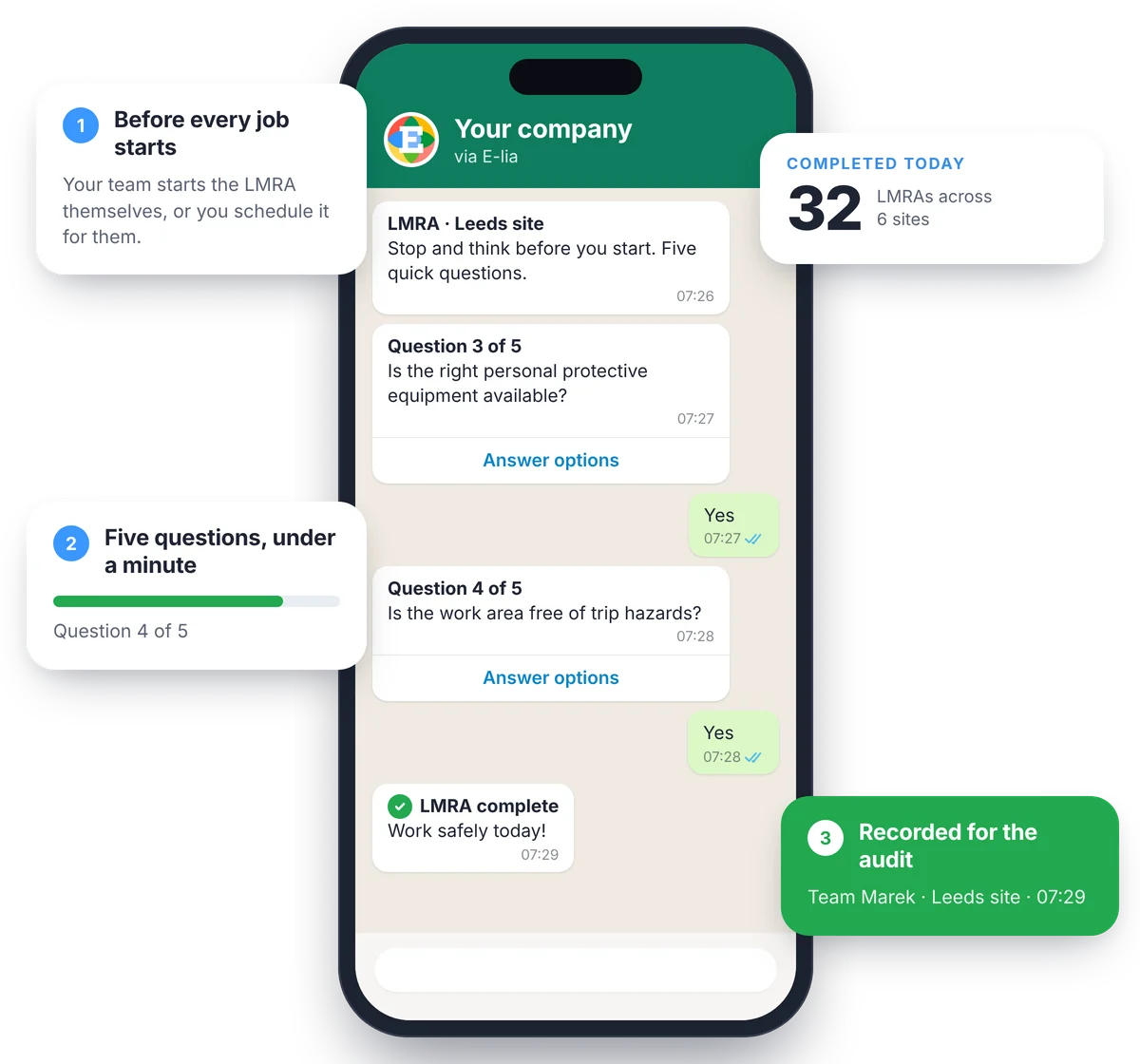
LMRA via WhatsApp: the Last Minute Risk Assessment without paperwork
The final check before work starts, on the phone your team already carries. Via WhatsApp, with photos, and an audit-ready report in your dashboard straight away.
Don’t just take our word for it: these organisations already see the benefits of E-lia.
 Read the customer story
 Read the customer story
 E-lia customer
 E-lia customer
 E-lia customer
 E-lia customer
 E-lia customer
 E-lia customerRead the customer storyRead the customer storyE-lia customerE-lia customerE-lia customerE-lia customerE-lia customerE-lia customer
What is an LMRA?
LMRA stands for Last Minute Risk Assessment, a quick point-of-work risk check that workers carry out themselves just before starting a task. Does the situation still match what was planned?
An LMRA takes two to five minutes and ends with one decision: start the work or not.
Read exactly what an LMRA involves, or download the free LMRA form.
The five questions of an LMRA
- Do I understand the task: what am I going to do, in what order and with whom?
- Do I know the hazards around me, including above and beside me?
- Do I have the right PPE and the right, inspected tools?
- Is the work area safe: barriers, set-up, lighting, isolated?
- Can I get away safely if something goes wrong?
Why stick with paper LMRA cards and Word documents?
Printing forms, deciphering scrawled handwriting and typing everything into Excel: a paper LMRA comes with far too much admin.
And the completed card always goes missing just when you need it for an inspection.
From paper to a WhatsApp flow
- Fully digital: no more paper checklists.
- Flexible start: started by the worker or sent as a push notification.
- Real-time view: act on issues straight away.
How it works: free LMRA demo
Try it yourself and see how smoothly a digital LMRA via WhatsApp runs. Nothing to install, instantly clear.
- Get an LMRA on your phone straight away
- See how easy it is to fill in
- Quickly see if it is right for your organisation
Request your WhatsApp demo now
All the benefits of LMRAs with E-lia
Digital & exportable
Nothing left lying around. Every completed LMRA is stored safely in E-lia and you export it for the auditor in one click.
Flexible start
Your workers start an LMRA themselves as soon as a task begins, or you send one out as an admin with a push notification.
Real-time view
Completed assessments appear live in your overview, so you see straight away where a risk lies and can step in.
ISO 45001 & audit-ready
Show at a glance at every audit that a risk check was carried out and signed off before the work started.
Ready to modernise safety at work?
See why more and more companies manage their LMRAs with E-lia. Quick to set up, results from day one.
- No extra app or account needed
- Up to 70% less admin
- Reports that are always audit-ready
Get in touch
From the blog
Read more about the LMRA
 Performing an LMRA: checklist & real-world examplePausing to check the risks just before the work starts: that is an LMRA. A checklist, a practical example and tips…
 How do you organise LMRAs for subcontractors and external workers?Standardise the process, make it multilingual and keep every record in one place, external workers included.
 Digital workplace inspection: form, checklist & appA toolbox talk instructs, an inspection checks. Find out what an inspection form should contain and how to follow up digitally…
Frequently asked questions about the LMRA
What does LMRA stand for?
Last Minute Risk Assessment. In the UK you will also hear it called a point-of-work or dynamic risk assessment.
It always comes down to the same thing: the very last risk check that workers carry out themselves, at the point of work, just before they start.
Who carries out an LMRA?
The worker who is going to do the job, for themselves. Only the person standing there at that moment can see what is different from the plan.
Working as a team? Then everyone does their own check, and any issues are discussed together before the start.
What is the difference between a task risk assessment and an LMRA?
The task risk assessment (often part of your RAMS) is drawn up in advance by the planner or HSEQ manager, for the task in general. The LMRA is done by the worker themselves, at the point of work, just before starting.
In short: the task risk assessment works out what could go wrong, and the LMRA checks whether that matches reality. More in this article.
Is an LMRA a legal requirement in the UK?
UK law does not use the term LMRA. Under the Management of Health and Safety at Work Regulations 1999 you must assess risks, and a point-of-work check shows that your risk assessment holds up on the day. Many principal contractors and clients ask for it.
Auditors, for example for ISO 45001, look not only at the procedure on paper but at whether it is applied in practice. Paper cards cannot show that.
When do you carry out an LMRA?
For every new task, and again whenever the situation changes: a different location, different weather, another trade working alongside or different tools after the break.
In practice that means several LMRAs a day per worker.
Do we have to keep using our paper LMRA cards?
Not at all. With cards you cannot see whether they are actually used, and you cannot prove it to a client.
With E-lia the same questions are in WhatsApp, with a QR code at the workplace or in the van. We copy the content of your current card exactly.
Why WhatsApp and not an LMRA app?
Most LMRA apps fail at the same point: downloading, signing up, updates. With subcontractors and agency workers it simply does not happen.
Via WhatsApp there is nothing to install or remember: scan, answer the questions, done. That is how our customers reach around 95% of their workers.
What do you see when someone answers ‘no’?
You see it straight away in your dashboard, with photo, time, location and name.
That way you can step in before the work starts, and an auditor sees not just completed forms but also what was done with them.