

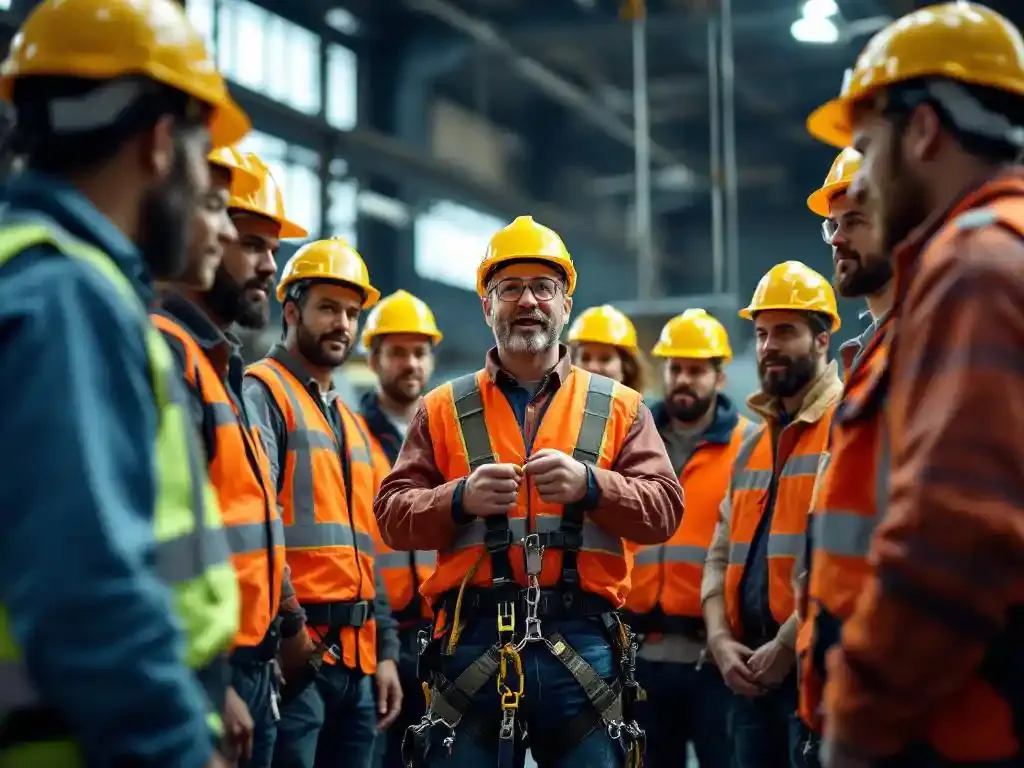
You can tick every box, with the right topic, the right time and a signed register, and still have a toolbox talk that nobody remembers by lunchtime. Engagement is what turns a talk into safer behaviour.
This article explains why workers switch off, which discussion techniques get people talking, how to use quizzes and games without turning safety into a joke, and how to involve your team in choosing topics and shaping safety rules, including your legal duty to consult.
Why workers switch off during safety talks
Disengagement is rarely laziness. It usually has a cause you can fix:
- "We've heard it all before." The same generic talk on PPE every quarter, read from the same sheet.
- Not relevant. A talk on scaffolding for a team that is fitting kitchens this week.
- One-way. The supervisor talks, the team listens, nobody is asked anything.
- Too long. Attention drops sharply after ten minutes standing in the cold.
- Bad timing. At the end of a shift, or while the lorry is waiting to be unloaded.
- Language. Workers who do not follow English well cannot join in and stop trying.
- Nothing happens. Issues raised last month were never fixed, so why speak up again?
- Fear of blame. Admitting a near miss might lead to trouble.
Most of these come down to one thing: workers do not see what the talk has to do with them. Engagement starts with relevance.
Make it about their work, today
The easiest way to engage people is to talk about what they are actually doing. Use photos from your own site, mention the job by name and connect the topic to this week's tasks.
- Instead of "manual handling", talk about "the plasterboard delivery on Thursday".
- Instead of a stock image, show the photo you took of the blocked fire exit yesterday.
- Instead of national statistics, describe the near miss in bay 4 last month.
A strong opening helps too. Our guide on how to conduct an effective toolbox talk covers openings, structure and timing.
Discussion techniques that get people talking
Ask open questions, then wait
"Any questions?" gets silence. Open questions get answers: "Where on this site could this go wrong?", "What slows you down when you try to do this safely?", "What would you change?" After asking, count to five in your head before saying anything. Silence means people are thinking.
Let workers bring the case
Ask someone in advance to share a near miss or a lesson from a previous job. Peers listen to peers. Rotating who brings the case also builds ownership.
Spot the hazard
Show a photo of a real work area and ask the team to find everything wrong with it. It takes two minutes and almost always starts a discussion.
Walk to the hazard
Hold the talk at the scaffold, the machine or the loading bay. Point at real things. Ask people to show you how they would do it.
Use "what if" scenarios
"The banksman has gone for a break and the driver wants to reverse. What do you do?" Scenarios turn rules into decisions people will actually face.
Make it safe to speak up
Thank people for raising problems, even uncomfortable ones. Never punish someone for reporting a near miss. Show what has been done with earlier suggestions. People talk when they trust that it is worth it.
Quizzes and gamification that work
A little competition keeps attention, as long as the safety message stays central.
- Three-question quiz at the end of the talk, by show of hands or on phones. It checks understanding and shows you where to repeat.
- True or false: state common myths ("A dust mask is fine for silica") and let the team vote.
- Team challenge: two groups, two minutes, who can list the most controls for a given hazard.
- Spot the difference: two photos of the same task, one safe and one not.
- Recognition: name the person who reported the most useful near miss this month.
Avoid rewarding "zero incidents". It encourages people to hide accidents instead of reporting them. Reward reporting, ideas and safe behaviour instead. For hands-on examples, see interactive PPE exercises for toolbox talks.
Prevent boring, repetitive toolbox talks
- Vary the format: a demonstration one week, a photo quiz the next, a short video, a walk-round.
- Vary the speaker: supervisor, experienced worker, safety adviser, an apprentice presenting what they learned.
- Refresh old topics: if PPE comes round again, focus on one item and one new angle, such as glove selection for a new chemical.
- Keep it short: ten minutes, three points, one action.
- Use the season: heat, cold, dark mornings, storms and holiday periods all give fresh angles.
Involve workers in choosing topics
When workers help choose the topics, they arrive interested. Simple ways to do it:
- ask at the end of each talk: "What should we cover next time?"
- keep a topic board or a WhatsApp poll where people can suggest subjects
- review near-miss reports and inspection findings with the team
- ask new starters what surprised or confused them in their first weeks
Balance this with your risk assessment. Workers' suggestions go into the plan alongside the topics your risks require, not instead of them.
Involve workers in safety rules: your duty to consult
Involving workers is not just good practice. In the UK, employers have a legal duty to consult employees on health and safety matters.
- Safety Representatives and Safety Committees Regulations 1977: where a recognised trade union has appointed safety representatives, you must consult them.
- Health and Safety (Consultation with Employees) Regulations 1996: for employees not covered by union representatives, you must consult them directly or through elected representatives.
- CDM 2015: on construction projects, the principal contractor must consult and engage with workers on matters affecting their health and safety.
Consultation covers things like changes to procedures, new equipment, the information and training you provide, and how risks are controlled. Toolbox talks are a natural place to do part of this: ask for feedback on a draft procedure, discuss a proposed change, or collect ideas. The HSE explains the rules on its worker involvement pages.
Record what was raised and what you did with it. That shows consultation took place, and it shows workers that their input matters.
Reach everyone, not just the front row
Engagement fails if people cannot understand the talk. On many UK sites, several languages are spoken. Use visuals, simple English and demonstrations, and give workers the key points in their own language. Read more in how to instruct employees who don't speak the language.
Do not forget night shifts, part-timers, agency workers and subcontractors. A short digital version of the talk on their phone keeps them in the loop.
How to tell if your talks are engaging
- Are people asking questions and raising issues without being prompted?
- Do quiz scores show the key message has landed?
- Are near-miss reports going up (a good sign) after talks on a topic?
- Do you see the agreed behaviour on site in the following days?
- Do workers suggest topics themselves?
Frequently asked questions
How do you make a toolbox talk interesting?
Make it about the team's own work this week, use real photos and objects, ask open questions, keep it to about ten minutes and vary the format and speaker.
What do you do if nobody says anything?
Wait a few seconds; silence is normal. Then make the question more specific, ask someone by name in a friendly way, or share a short example yourself to lower the threshold.
Does gamification work for safety talks?
Yes, in small doses. Quick quizzes, hazard-spotting and team challenges keep attention and check understanding. Avoid rewards for "no incidents", which can discourage reporting.
Do I have to consult workers about health and safety?
Yes. UK employers must consult employees, either through trade union safety representatives (1977 Regulations) or directly or via elected representatives (1996 Regulations). On construction projects, CDM 2015 adds a duty to consult and engage with workers.
How do I engage workers who resist toolbox talks?
Ask them what they would cover, invite them to share their experience, keep talks short and relevant, and show that issues they raise get fixed. Resistance often fades once people see the talks are for them, not for the paperwork.
Engaging toolbox talks via WhatsApp with E-lia
E-lia sends short, visual toolbox talks to your workers via WhatsApp, in their own language, with no app or login. Each talk takes 5 to 8 minutes and ends with a quick knowledge check, so you see straight away whether the message landed. About 95% of workers are reached at our customers, including night shifts, agency staff and subcontractors.
Experience an engaging toolbox talk
Receive a sample toolbox talk with a knowledge check via WhatsApp.