

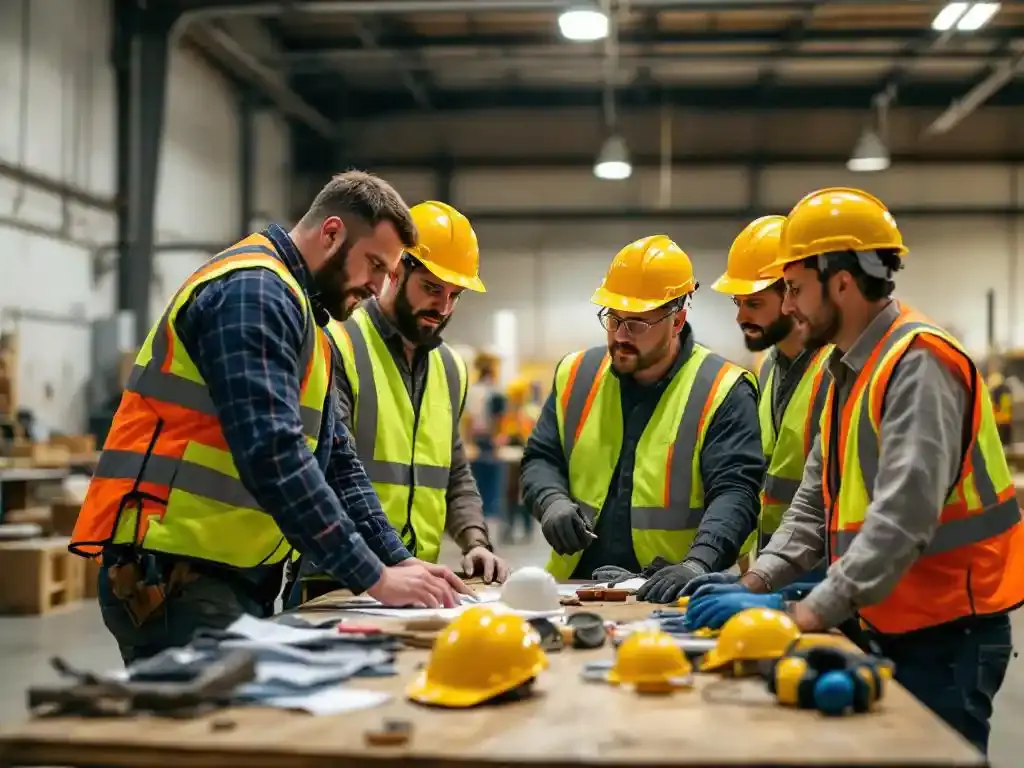
Most workers have heard the PPE talk so often they can recite it. That is exactly the problem: a supervisor reading out rules while the crew looks at their boots changes nothing. A PPE toolbox talk works when people handle the kit, discuss real situations and answer questions themselves.
This guide gives you practical, interactive PPE exercises and demonstrations, dilemmas and real cases to discuss, task-specific PPE talks for work at height, confined spaces, respiratory and eye protection, a seasonal planning approach, how to follow up agreements and deal with refusal, and a set of quiz questions you can use straight away.
Why interactive PPE toolbox talks work better
Under the PPE at Work Regulations 1992, employers must not only provide PPE but also give information, instruction and training on how to use it, in a way workers understand. A PPE talk that nobody remembers does not meet that aim.
People remember what they do and discuss far better than what they hear. Interactive talks also surface the real reasons PPE is not worn: it does not fit, it fogs up, it is not available where the work is. Those are things you can fix. For the legal basics of which PPE is required for which hazard, see mandatory PPE at work.
Interactive PPE exercises and demonstrations
1. Spot the mistake
Ask a volunteer to wear PPE with three deliberate errors: helmet back to front, chin strap loose, safety glasses on top of the head, earplugs half in, harness leg straps slack. The group has one minute to find all of them. It is quick, fun and every error is one you see on site.
2. Inspect it yourself
Bring a mix of good and worn-out kit: a cracked helmet, a harness with frayed webbing, gloves with holes, a respirator with a perished seal. Pairs inspect one item each and decide: use, report or bin. Then discuss what they found and how to report defects.
3. Fit and check in pairs
Workers fit their own PPE and a colleague checks it against a simple list. For RPE, practise the pre-use seal check. For harnesses, check that the dorsal D-ring sits between the shoulder blades and straps are snug.
4. Choose the right kit
Lay out several types of gloves, glasses or hearing protection. Give each team a task card ("cutting steel sheet", "mixing a cleaning chemical", "using a breaker for 2 hours") and ask them to pick the right item and explain why. This teaches that PPE is chosen for the hazard, not grabbed at random.
5. Noise reality check
Use a sound level meter or app to measure a few tools on site. Then show how long the same noise is safe with and without hearing protection. Hearing loss is slow and invisible, so making it concrete helps.
6. Donning and doffing
For chemical or contamination risks, practise taking off gloves and overalls without touching the outside. Use a little washable paint or powder on the gloves to show where contamination ends up.
PPE dilemmas to discuss with your team
Dilemmas get people talking because there is no obvious "right" answer to recite. Ask the group what they would do, and why.
- "It's only a two-minute job, do I really need the glasses?"
- "My safety glasses fog up under my mask, so I take them off."
- "The new lad isn't wearing ear defenders. Do I say something?"
- "My gloves are worn through, but the store is closed until tomorrow."
- "The client's site rules say helmets everywhere, but we're in the welfare cabin area."
- "My harness is in the van, the ladder is right here."
Close each one by agreeing what the team will do next time, and what you as the employer will fix (anti-fog glasses, a spares box, a better process).
Using real-world PPE cases and incidents
Real stories stick. Good sources are your own near miss and incident reports, cases from your sector and HSE prosecution summaries. When you use them:
- Describe what happened in plain words, without blaming individuals.
- Ask the group what went wrong and at which moment it could have been stopped.
- Connect it to your own site: "Where could this happen here?"
- Agree one specific action.
Also share positive cases: a helmet that took a falling bolt, safety boots that stopped a pallet edge. Ask workers to share their own experiences. Those are usually the most powerful talks of all.
Task-specific PPE toolbox talks
| Topic | Key legislation | What to cover and practise |
|---|---|---|
| Work at height | Work at Height Regulations 2005 | Collective protection first; harness and lanyard checks; correct anchor points; never working alone on a harness; the rescue plan and suspension trauma |
| Confined spaces | Confined Spaces Regulations 1997 | Entry only under a safe system of work; gas monitoring; breathing apparatus and rescue equipment; never entering to rescue a colleague without training |
| Respiratory protection | COSHH 2002; HSE guidance on RPE | Dust and fume hazards such as silica; choosing the right filter; face fit testing; being clean-shaven where the seal requires it; pre-use checks; storage |
| Eye and face protection | PPE at Work Regulations 1992 | Grinding, cutting, chemicals and welding; glasses vs goggles vs face shield; anti-fog options; eyewash stations |
| Hearing protection | Control of Noise at Work Regulations 2005 | Hearing protection zones; correct earplug insertion; wearing protection for the whole time in noise |
Download our free working at height toolbox talk or PPE toolbox talk to get started.
Seasonal PPE themes and how often to repeat PPE topics
Plan PPE topics around the year, so the talk is relevant to what workers are dealing with right now:
- Winter: cold and wet weather clothing, gloves that still allow grip, hi-vis in the dark, slips on ice.
- Spring: start of the outdoor season, checking kit that has been stored, pollen and dust.
- Summer: sun protection and UV, PPE in the heat, hydration, keeping helmets on when it is hot.
- Autumn: visibility as days shorten, wet conditions, footwear grip.
Cover a core PPE topic at least every few months, and always when something changes: new kit, new tasks, a new site, after an incident or when observations show slipping standards. Short, frequent talks beat one long annual session.
Adapting PPE talks for different teams and experience levels
- New starters: the basics, hands-on, with a buddy. Check understanding, especially if English is not their first language.
- Experienced workers: skip the basics. Use dilemmas, near misses and peer checks, and ask them to lead the demonstration.
- Different sites and teams: make the talk specific to the actual tasks, tools and kit on that site.
Following up PPE agreements and dealing with refusal
A talk without follow-up is soon forgotten. After each PPE talk:
- Record what was agreed and who will do what by when.
- Fix the practical barriers people raised: sizes, comfort, availability.
- Check on site in the following days during walks and workplace inspections, and give feedback straight away.
- Start the next talk with what you observed, good and bad.
When someone refuses to wear a helmet or other PPE
First find out why. Common reasons are discomfort, heat, poor fit, interference with other PPE or "it's never happened to me". Many of these you can solve with different models, sizes or accessories.
Explain the risk and the rule, and that workers have a legal duty to use PPE provided for them. If refusal continues without a valid reason, it becomes a management matter and you should follow your disciplinary procedure. Note that turban-wearing Sikhs are legally exempt from wearing head protection in most workplaces.
PPE quiz questions for your toolbox talk
- Where does PPE sit in the hierarchy of control? (Last, after elimination, substitution, engineering and administrative controls.)
- Can your employer charge you for PPE you need for the job? (No.)
- At what noise level must hearing protection be worn? (85 dB(A) daily or weekly exposure, the upper exposure action value.)
- What should you do if your PPE is damaged? (Stop using it and report it straight away.)
- Why does a tight-fitting mask need a face fit test? (Without a good seal, contaminated air leaks in around the edges.)
- What must be in place before anyone works on a fall arrest harness? (A rescue plan.)
- When should a safety helmet be replaced? (After an impact, when damaged, or at the manufacturer's expiry date.)
Frequently asked questions
How long should a PPE toolbox talk last?
Ten to fifteen minutes face-to-face is enough for one focused topic and one exercise. Digitally, a talk with a short knowledge check takes 5 to 8 minutes.
How often should PPE be covered in toolbox talks?
Cover core PPE topics at least every few months and whenever tasks, kit or sites change, after incidents and when observations show standards slipping.
How do I make PPE talks interesting for experienced workers?
Let them lead. Ask experienced workers to demonstrate, share near misses and discuss dilemmas rather than listening to rules they already know.
How do I check that the PPE talk worked?
Use a short quiz at the end, and then observe PPE use on site in the following weeks. Compare observations before and after the talk.
Interactive PPE toolbox talks with E-lia
E-lia sends toolbox talks via WhatsApp with images, short video and quiz questions, in each worker's own language. No app, no login, done in 5 to 8 minutes, with every answer recorded in your dashboard. Use it to prepare a face-to-face PPE talk, to reach people who missed it, or for seasonal reminders. Pick from 80+ ready-made toolbox talk topics or have your own PPE rules imported.
Try an interactive PPE toolbox talk
Receive a real toolbox talk with quiz questions on your own phone.